
Process Modeling (BPMN)
An organisation can scale its activities if it has established robust process descriptions that are followed to create repeatable and steerable activities.
BPMN stands for Business Process Model and Notation. It is a notation standard that is used worldwide to draw business processes. By businesses, we mean any type of organisation, including commercial companies but also government bodies and non governmental organisations.
Over the past decades, various standards for process modelling have been introduced. The broad adoption of BPMN as a standard language is expected to bring consistency to the expression of general business process concepts, such as public and private processes and choreographies, as well as advanced process concepts, such as error handling and transaction compensation.
BPMN has since become a standard for modelling business processes and representing them in a Business Process Diagram (BPD). The methodology used is very similar to the activity diagrams of the Unified Modeling Language (UML). The aim of BPMN is to clarify business process management for both technical and non-technical users by using a notation that feels intuitive to non-technical users while still being capable of representing complex process semantics. The BPMN specification also forms a bridge between the graphical representation and the underlying constructs of executable languages, such as the Business Process Execution Language (BPEL).
The primary goal of BPMN is to provide a standard notation that can be understood by all stakeholders. This includes business analysts who create and refine processes, technical developers who implement those processes, and process owners who manage them. BPMN is therefore used as a common language that bridges the communication gap that often arises between the design and implementation of a business process.
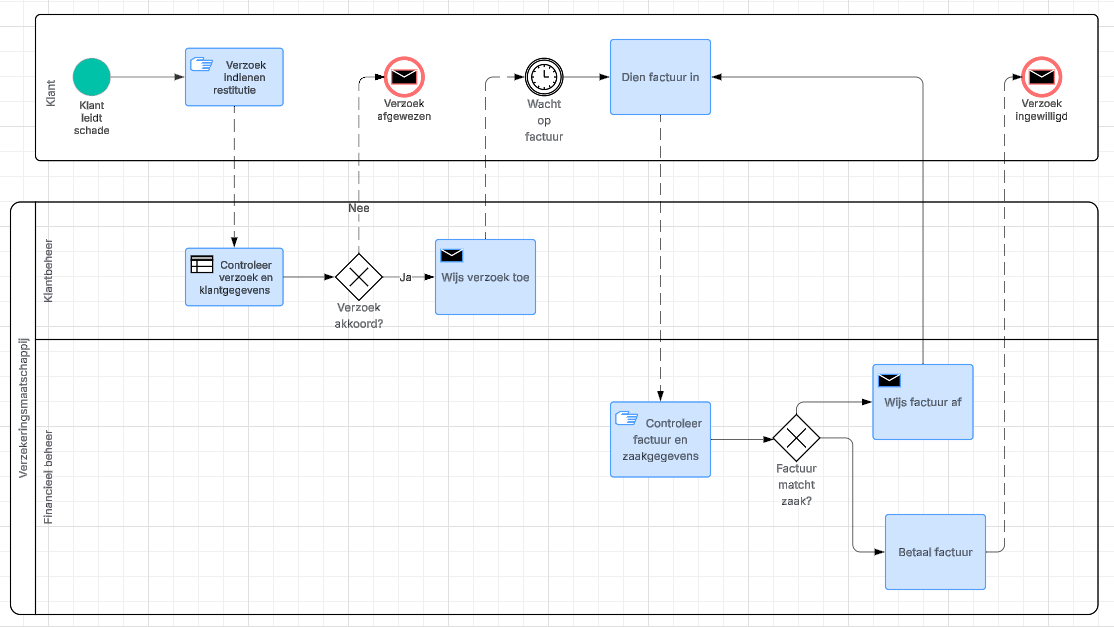
Why use BPMN in business analysis?
A BPMN diagram is not only a way to document a process. It is also a powerful tool for analysing problems in a process. Drawing the process forces you to make every step, role and decision explicit, and that is often where problems become visible. BPMN helps you to:
- Visualise the process. Mapping out the steps shows the sequence of activities and makes it easier to spot bottlenecks or delays.
- Clarify roles and responsibilities. Pools and lanes show who does what. This reveals overlaps, gaps or unclear responsibilities, and shows which stakeholders are involved in or affected by a problem.
- Identify hand-offs and dependencies. Problems often arise where work passes from one role or department to another. The diagram also shows how a delay in one step affects the steps that follow.
- Analyse decision points. Gateways show where decisions are made and which paths a process can take. Analysing them can reveal inefficient routes or decisions that lead to errors.
- Document the current and desired state. An as-is diagram describes how the process works today. A to-be diagram describes the desired future process. Comparing the two shows the gaps and the changes that are needed.
- Support root cause analysis. Breaking the process down into individual steps helps you find the underlying causes of a problem, and shows where the process varies between cases.
- Enable simulation and measurement. BPMN models can be used in simulation tools to test the impact of a change before it is implemented, and they help to define KPIs to monitor the process afterwards.
- Facilitate communication. Because the notation is standardised, business analysts, process owners and IT professionals can discuss the same diagram. Drawing it together with stakeholders also makes sure their knowledge is included.
In practice, using BPMN in a problem analysis often follows these steps:
- Map the current (as-is) process.
- Identify bottlenecks: where does the process slow down or go wrong?
- Analyse the decision points (gateways) for inefficiencies or incorrect decisions.
- Review the hand-offs between roles and departments.
- Document the findings and identify the root causes.
- Develop solutions for the identified issues.
- Draw the to-be process that incorporates the proposed solutions.
- Implement the changes and use the diagram to monitor whether the solutions are effective.
Process diagrams are not stand alone. The design of solutions for an organisation go hand in hand with various architectural designs of the organisation itself and relate to different levels of the organisation. A BPMN diagram could be related to one or more functions in corresponding [use case diagrams]. The process could be preceded or followed by other processes that make use of the same information. It might also have to follow conventions or uniform sets of data because of management models and compliance requirements.
Starting Points
Key Points
- You are able to determine when to draw a BPMN diagram
- You can explain how a BPMN diagram supports the analysis of problems in a business process (e.g. bottlenecks, hand-offs, decision points)
- You are able to identify the start and end events, intermediate events, tasks and gateways for the process from a case description
- You are able to draw a BPMN diagram following the specification
- You can draw an as-is and a to-be diagram and explain the differences between them
- You can read and explain a BPMN diagram when presented to you
- You can explain the difference between the various types of objects